Connect6 vs AI
Play Connect6 (six-in-a-row) free in your browser. No download and no sign-up: a fairer cousin of Gomoku played on a 19x19 board where, after Black's opening single stone, both players place two stones every turn and race to line up six. Take on four AI levels, a friend on one screen, or an online room you share by link.
Connect6 was introduced in 2003 by Professor I-Chen Wu as an elegant fix for the first-player advantage that plagues Gomoku. The idea is simple but profound: Black opens by placing a single stone, and from then on each player places two stones per turn. Because every turn adds the same number of stones for both sides, the tempo is balanced and the game has been shown to be far fairer than Five-in-a-Row, with no need for the complicated opening restrictions Renju requires. The goal is to be first to get six (or more) of your stones in an unbroken line — horizontally, vertically, or diagonally.
Why Play Connect6 Here
Everything runs right in your browser. There's no app to install and no account to create — open the page, the empty 19x19 board is ready, and you close the tab when you're done. It works the same on a phone, tablet, or desktop, and your session record is stored locally.
Play solo against the computer at four strengths, pass-and-play with a friend on one screen, or open an online room and invite someone with a single link. As you place your two stones, the move is committed automatically; legal points preview on hover, the last move is marked, the winning six light up, and undo, hint and full replay are there whenever you want them.
The Rules in One Minute
The board is a 19x19 grid of intersections. Black moves first and places exactly one stone. After that, players alternate and each turn places two stones on any empty points.
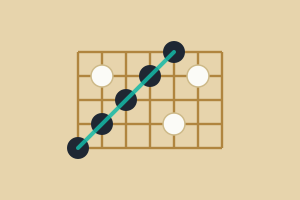
The first player to form a continuous line of six or more of their own stones — in any of the four directions — wins immediately. If the board fills with no six-in-a-row, the game is a draw, which is extremely rare in practice.
Why Two Stones Changes Everything
In Gomoku a single 'open four' is usually game over. In Connect6 your opponent gets to place two stones in response, so they can block one threat and still develop their own attack. That means a single threat is rarely enough — you need to create double threats that two defensive stones cannot both neutralise.
Conversely, defense is more powerful too: with two stones you can block and counter-attack in the same turn. The result is a tense, swinging battle of simultaneous attack and defense that feels quite different from ordinary five-in-a-row.
Strategy for Beginners
Think in pairs. Don't spend both stones on one idea — try to place two stones that each extend a different potential line, forcing your opponent to choose what to block.
Watch for opponent 'fours'. Any line where the opponent has four stones inside a six-window with two open points is lethal: they can complete six next turn. You must spend a stone to break it. Keep your stones connected and flexible, and remember that controlling the center gives your lines the most room to reach six.
Tips to Improve Faster
- Place your two stones on two different lines to build double threats.
- A single threat is easy to block — aim for two at once.
- Break any opponent line that could become six on their next turn.
- Use one stone to defend and the other to attack in the same turn.
- Fight for the center; edge lines run out of room before reaching six.
Frequently Asked Questions
How is Connect6 different from Gomoku?
Connect6 needs six in a row instead of five, is played on a 19x19 board, and after Black's first single stone each player places two stones per turn — which makes it much fairer.
Why does Black play only one stone first?
The single opening stone balances the game. From the second turn onward both players place two stones each, so neither side enjoys a tempo advantage.
How do I win?
Be the first to line up six or more of your stones in an unbroken row horizontally, vertically, or diagonally.
Can I play Connect6 against the computer?
Yes. Choose Solo vs AI and pick easy, medium, hard or Master. The AI spots winning placements, blocks your threats, and builds its own.
Is a draw possible?
In theory, if the whole board fills with no six-in-a-row. On a 19x19 board this almost never happens.