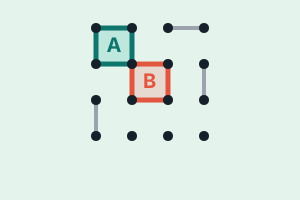
Dots and Boxes vs AI
Play Dots and Boxes free in your browser. No download and no sign-up: take turns drawing a line between two dots, complete the fourth side of a box to claim it, and chain captures together to take the most squares. Take on four AI levels, a friend on one screen, or an online room you share by link.
Dots and Boxes is a classic pencil-and-paper game for two players on a grid of dots. Players alternate drawing a single horizontal or vertical line between two adjacent dots. Whenever your line completes the fourth side of a 1×1 box, you claim that box, mark it with your color, and immediately move again. When all lines are drawn, whoever owns more boxes wins. It takes seconds to learn but hides a surprising amount of strategy: the player who understands chains, sacrifices and the double-cross almost always beats the one who simply grabs every box on offer.
Why Play Dots and Boxes Here
Everything runs right in your browser. There's no app to install and no account to create — open the page, pick a board size, and start tapping the gaps between dots. It plays the same on a phone, tablet or desktop, and your session record is stored locally.
Play solo against the computer at four strengths, pass-and-play with a friend on one screen, or open an online room and invite someone with a single link. Choose a 4×4, 5×5 or 6×6 grid, tap any empty edge to draw it, and watch boxes fill with your color the moment you close them — complete a box and you get to move again.
The Rules in One Minute
On your turn, draw one line connecting two neighboring dots — horizontally or vertically. If that line completes a box (its fourth side), you mark the box as yours and take another turn straight away. If your line completes two boxes at once, you score both and still move again.
If your line doesn't close any box, your turn ends and play passes to your opponent. The game ends when every possible line has been drawn; the player with more boxes wins. On an even grid a tie is possible, so the higher box count is what matters.
Chains and the Double-Cross
The heart of the game is the chain — a run of connected boxes that all fall at once when someone opens it. Beginners grab every free box and then are forced to open the next chain for the opponent. The skill is to control who is forced to open chains, using the parity of the board and small sacrifices.
The key advanced trick is the double-cross: instead of taking the last two boxes of a long chain, you decline them and play a line that hands those two boxes to the opponent — but forces them to open the next chain for you. Sacrificing two boxes to win a much longer chain is how strong players turn the endgame around.
Strategy for Beginners
Early on, draw lines that don't give a box away — avoid making the third side of any box, because that lets your opponent complete it. When all the safe moves run out, someone has to open a chain; try to be the one who opens the shortest chain and leaves the long ones for later.
Think about long chains, not single boxes. The general rule of thumb: try to make the number of long chains come out in your favor (the chain rule), and once you're winning a chain battle, use the double-cross to keep your opponent on the back foot. Counting boxes greedily is the fastest way to lose.
Tips to Improve Faster
- Don't draw the third side of a box unless you have to — it gives a free box away.
- Count safe moves left; when they run out, plan who is forced to open a chain.
- Open the shortest chain first and save the long chains for the double-cross.
- Use the double-cross: decline the last two boxes to force the next chain open.
- Plan the number of long chains in your favor (the chain rule).
- Completing a box gives an extra turn — chain captures together in one move.
Frequently Asked Questions
How do you win at Dots and Boxes?
Claim more boxes than your opponent. You claim a box by drawing its fourth side, and the player owning the most 1×1 boxes when every line is drawn wins.
Do I really get an extra turn for completing a box?
Yes. Each time a line completes one or two boxes, you score them and immediately move again. You keep moving as long as you keep closing boxes.
What is the double-cross strategy?
Instead of taking the last two boxes of a long chain, you give them to your opponent with a single line that forces them to open the next chain for you. Sacrificing two boxes to win a longer chain is the core winning idea.
What board sizes can I play?
You can choose a 4×4, 5×5 or 6×6 grid of boxes. Larger boards create longer chains and reward stronger chain-control play.
Can I play Dots and Boxes against the computer?
Yes. Choose Solo vs AI and pick easy, medium, hard or Master. The stronger levels avoid giving away boxes and solve the endgame with chain counting and the double-cross.