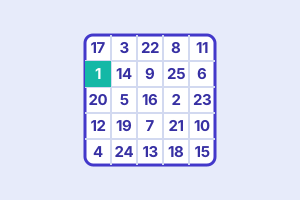
Schulte Table
Play Schulte table free in your browser — no download, no sign-up. Tap numbers 1 through N in order on a shuffled grid; get interval curves, distraction counts and personalized training tips.
The Schulte table is a classic attention drill used by pilots, athletes and students. A square grid holds shuffled numbers; your job is to find 1, then 2, then 3, as fast as you can without mis-clicks. It trains sustained focus, eye movement control and peripheral scanning — and our version adds click-interval analysis so you can see when fatigue or distraction kicks in.
Why Play Here
Runs entirely in your browser. Pick 3×3 through 7×7, tap Start, and the timer begins on your first correct click.
After each round you get an SVG attention curve, average interval, best streak, distraction count, star rating and AI-style coaching text — all computed locally.
How to Play
Choose a grid size. Tap Start (or Reset for a new shuffle). Find number 1, then 2, up to the last cell.
Wrong taps are counted but don't end the round. Finish all numbers to see your time, rank among local records, and full analysis.
Training Tips
Keep your eyes on the center and scan outward — don't jump your gaze cell by cell unless the grid is very small.
Start at 5×5 until errors are rare, then move to 6×6 or 7×7 for longer sustained focus.
Use the analysis tab to spot fatigue points; if the curve spikes mid-round, take a short break before the next attempt.
Quick Tips
- Relax your shoulders — tension slows peripheral search.
- Say the next number silently to reduce mis-clicks.
- Practice at the same time of day to build a consistent baseline.
- If errors pile up, drop one grid size for two clean rounds.
- Compare best times per size in Records — progress is often clearer than a single round.
Frequently Asked Questions
What grid size should I start with?
Most people begin at 5×5. Use 3×3 or 4×4 to learn the rhythm, then work up to 6×6 and 7×7.
Do wrong clicks stop the timer?
No. Errors are counted and highlighted, but the round continues until every number is found.
What does the attention curve show?
Each point is the time between consecutive correct taps. Long spikes usually mean hesitation or distraction.
Are scores saved?
Yes. Best time per grid size and your last 20 rounds are stored locally in your browser.